














Blog
Drill Line Automation Guide for Fabricators

A drill line automation guide should start with the work arriving at the machine, not with the machine specification. An automated drilling line can reduce handling, improve hole position accuracy and increase throughput, but only when profiles, job data, tooling and downstream operations are organised to support it. For fabrication businesses processing repetitive structural steel, plate or bar work, automation is a production decision rather than a standalone capital purchase.
Define the work the drill line must handle
Begin with actual production records. Review the steel grades, section sizes, lengths, hole diameters and daily tonnage that pass through the workshop over a representative period. A line sized around occasional maximum sections can leave expensive capacity underused; one selected only for average work may create a bottleneck as soon as larger members arrive.
Consider the whole drilling requirement, including through-holes, tapped holes, slots, marking, scribing and countersinking where applicable. Some operations may be better completed on a drilling line, while others belong on a machining centre or in a separate finishing cell. The correct answer depends on the job mix, tolerances and quantity involved.
Material condition also matters. Scale, burrs, camber and inconsistent cut lengths affect loading, clamping and drilling performance. If incoming material varies significantly, address that issue before expecting automation to compensate for it. A well-specified line cannot correct poor profile preparation or unreliable saw output.
Map material flow before choosing automation
The drilling cycle is only one part of the process. Measure the time from material delivery to loading, drilling, inspection, unloading, assembly and dispatch. In many workshops, operators spend more time locating, turning and moving steel than the machine spends cutting holes. Automation delivers its best results when these hand-offs are planned as one system.
A practical layout provides enough space for infeed stock, machine access, outfeed and finished-job sorting. It must also allow safe fork-lift movement without placing pedestrians in the path of long sections. Avoid designing a line where operators need to retrieve offcuts or inspect parts inside a material-handling route.
Powered infeed and outfeed conveyors can reduce manual handling, but they need adequate accumulation length. If finished material cannot clear the outfeed promptly, the drill line will wait. Likewise, a saw or coping station feeding the line needs a realistic buffer so a short interruption does not stop the full cell.
For a fabrication shop processing one-off assemblies, the best arrangement may use manual loading with programmed stops and clear job identification. For repetitive structural work, automatic measuring, material transfer and sorting can be justified. The level of automation should match production repeatability, not simply the ambition to run unattended.
Establish a reliable data route
Automated drilling depends on accurate production data. Drawings or model files need to be converted into machine-ready programmes, checked and released under a controlled process. A misplaced revision, incorrect material grade or unconfirmed hole reference can turn a fast line into a fast way of producing scrap.
Define who owns programme preparation, who verifies the first-off part and how amendments are recorded. This is especially important where estimators, detailers, workshop supervisors and machine operators all handle the same job information. The programme should carry a clear job number, part mark and revision status that can be checked at the machine.
Barcode or label-based identification is worthwhile when several jobs are active at once. It reduces the risk of loading the right programme for the wrong member and gives operators a direct link between physical steel and production documentation. It also improves traceability when a customer query arises after dispatch.
Select tooling for consistency, not just cutting speed
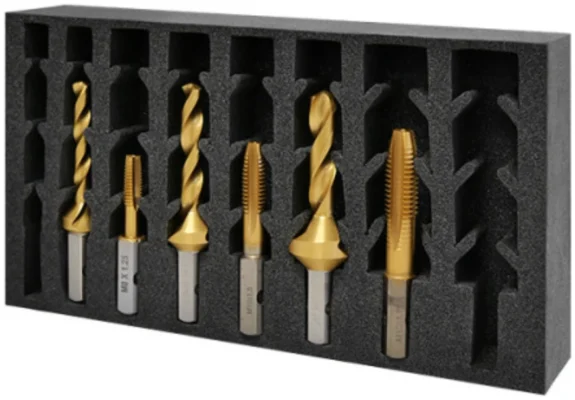
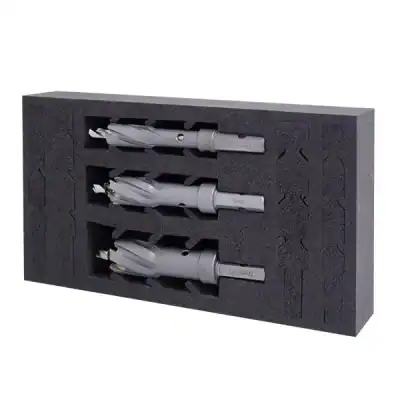
The drill line is only as dependable as its drills, holders, coolant and maintenance routine. Annular cutters, carbide drills and solid drill systems each suit different diameters, materials and hole-quality requirements. The cheapest cutter is rarely the lowest-cost option if it creates frequent changes, overheats or leaves excessive burrs.
Match the tooling to the steel grades routinely processed. Higher-strength material, thick flanges and interrupted cuts place greater demand on both the cutting edge and machine setup. Use the recommended speeds and feeds, then monitor actual tool life rather than relying solely on catalogue figures. A gradual fall in hole quality can point to worn tooling, inadequate coolant concentration, poor clamping or spindle run-out.
Keep tool management close to the machine. Operators need clearly identified tools, a controlled regrind or replacement process and enough stock to avoid holding up a scheduled job. For high-volume work, recording tool life by diameter and material type will support more accurate planning and purchasing.
Coolant management deserves the same attention. Check concentration, fluid condition, filtration and delivery to the cutting area. Contaminated coolant can shorten tool life, affect surface finish and create unnecessary housekeeping problems around the line.
Build quality checks into the operating routine
Automation improves repeatability, but it does not remove the need for inspection. Confirm hole diameter, spacing, edge distance and part orientation at the first-off stage. Where drilling is fed from digital detailing, first-off checks validate both the programme and the physical datum used by the machine.
After that, inspection frequency should reflect the risk of the work. Critical connection plates, parts with close positional tolerances and long production runs deserve planned checks rather than occasional visual inspection. Gauges, calibrated callipers and job-specific templates can make these checks quick without slowing the operation unnecessarily.
Burr control is also a quality and safety issue. Burrs can interfere with fit-up, make handling hazardous and add avoidable work at assembly. Determine whether the line, a secondary deburring process or an adjustment to cutting parameters is the most effective remedy.
Make safety part of the specification
A drilling line handles heavy, moving steel and high-speed cutting tools. Guarding, emergency stops and interlocked access points are essential, but safe output also relies on clear working methods. Operators must know where they can stand during loading and transfer, how to deal with a jammed section and when isolation is required before intervention.
Risk assessment should cover the full cell: overhead lifting, fork-lift routes, conveyor pinch points, swarf removal, coolant exposure and noise. Do not treat automatic material handling as a reason to reduce supervision. It changes the hazards rather than removing them.
Training should cover programme selection, datum checks, safe recovery from faults, routine cleaning and basic tool-condition assessment. The people running the line are often the first to spot a developing issue, provided they are given ownership of the process and a clear route to report it.
Plan maintenance around production reality
Unplanned downtime is costly because it affects more than one operation. A stalled drill line can hold up saw cutting, fitting, welding and dispatch. Preventive maintenance should therefore be scheduled around production demand and recorded properly, not deferred until a failure occurs.
Daily checks normally include lubrication, coolant level, swarf removal, guards, clamps and visible leaks. Weekly and monthly tasks may cover conveyor alignment, spindle condition, filters, sensors and emergency-stop function. The exact schedule depends on the equipment and duty cycle, but it should be specific enough that different operators complete it consistently.
Keep critical consumables and wear parts available on site where practical. That can include commonly used cutters, coolant supplies, filters, clamps and sensor components. Holding every possible spare is unnecessary, but waiting several days for a small part that stops production is rarely a sensible saving.
Measure whether automation is paying back
Track useful measures from the first weeks of operation: drilled parts per shift, metres or tonnes processed, setup time, tool consumption, scrap, rework and downtime by cause. These figures show whether the constraint is truly the drilling cycle or somewhere before or after it.
Payback is not limited to labour reduction. Better hole accuracy can reduce fitting time. Consistent marking can prevent assembly errors. Faster programme changeover can make smaller batches commercially viable. Equally, a line that needs frequent manual correction may not deliver its forecast return until upstream data and material handling are improved.
The right drill line automation project gives the workshop more control over its flow of work. Start with the steel, the data and the people who operate the process each day, then specify the automation that removes a real constraint rather than adding a more expensive one.