



















Blog
Plate Rolling vs Section Rolling Explained
If you are pricing a rolled component for a tank shell, handrail, cone section or structural ring, the difference between plate rolling vs section rolling is not academic. It affects machine choice, achievable radius, material behaviour, weld preparation and, ultimately, whether the part fits first time on the shop floor.
Both processes are used to form metal into curves, but they deal with very different starting materials and place different demands on tooling and setup. For fabrication shops, maintenance teams and engineering buyers, knowing where one process ends and the other begins helps avoid poor tolerances, unnecessary handling and expensive rework.
Plate rolling vs section rolling: the basic difference
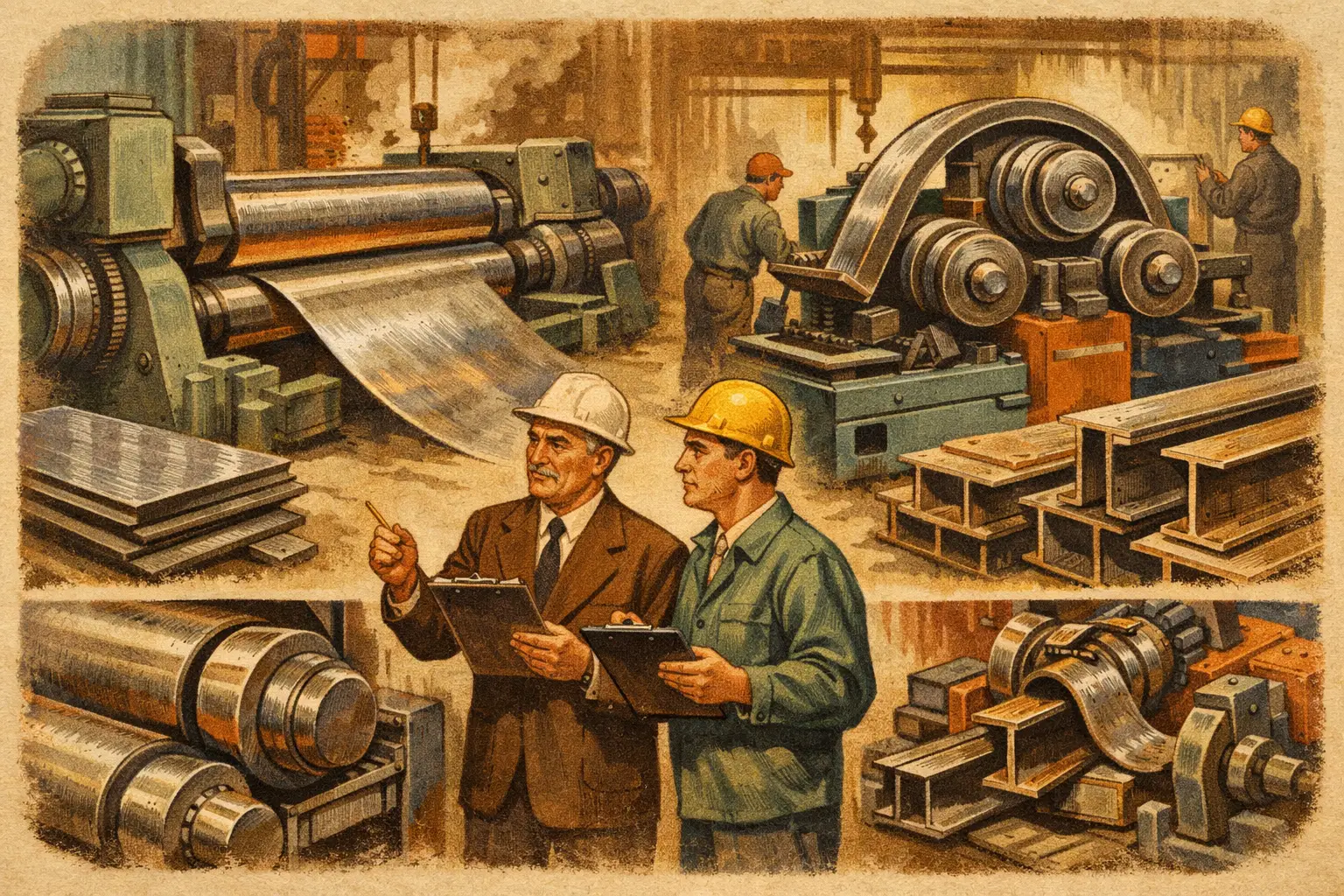
Plate rolling forms flat plate into a cylindrical or conical shape using a set of rolls. The material starts as sheet or plate and is progressively bent until it reaches the required diameter or radius. This is the process typically used for shells, drums, pipe sections, silencers, pressure parts and large fabricated cylinders.
Section rolling bends pre-formed profiles rather than flat material. That includes angle, flat bar, box section, channel, tube, I-beam and other structural or hollow sections. Instead of creating a shell from plate, section rolling follows the geometry the section already has and curves it to suit the application.
That sounds straightforward, but the practical difference is more than just shape. Plate rolling is mainly about distributing bend across a flat surface while controlling diameter and edge condition. Section rolling is about curving a profile without twisting it, flattening it or distorting critical dimensions.
Where plate rolling is usually the right choice
Plate rolling is suited to jobs where the finished part needs continuous surface area. If you are making a vessel body, chute, hopper section, lined duct, rolled casing or cover, plate is the obvious starting point. Once rolled, the seam can be welded, dressed and integrated into a fabricated assembly.
The main variables are plate thickness, width, material grade and finished diameter. Thicker plate and tighter diameters need more machine capacity and often more careful pre-bending at the leading and trailing edges. Without that pre-bending, you are left with flat sections at the ends that need secondary work or trimming.
This matters when a rolled shell needs accurate fit-up for longitudinal seams, circumferential joints or flanges. If the plate is not properly pre-bent, the welder ends up pulling material into line during assembly. That costs time and can introduce stress into the finished component.
Plate rolling also gives flexibility where custom diameters are required in low or medium batch work. For many fabrication businesses, that makes it practical for one-off specials and project work where standard tube or pipe sizes do not suit the design.
Typical plate rolling applications
Common examples include tank shells, ducting, rolled covers, machine guards, augers, cones, transition pieces and fabricated pipework. Stainless, mild steel and aluminium can all be rolled, but each behaves differently. Springback, surface marking and minimum achievable radius vary by grade and thickness.
Where section rolling makes more sense
Section rolling comes into its own when the job calls for curved structural members or framed components. If the part is a rolled angle ring, curved RHS, handrail, hoop, support frame or architectural arc, section rolling is usually the correct route.
The challenge is that a section is not neutral in the way a flat plate is. Different parts of the profile resist bending differently, and some sections are far more prone to twisting or local deformation. A flat bar rolled the easy way behaves very differently from a channel rolled on edge. Tube can ovalise. Angle can climb or spiral if guidance is poor. Box section can show wall distortion if the radius is pushed too tight.
That is why section rolling often relies heavily on profile-specific tooling, side supports and operator experience. The target is not just achieving a radius. It is holding the section in shape while doing it.
Typical section rolling applications
Typical jobs include rolled frames, staircase stringers, balustrades, circular supports, railings, rolled cleats, structural rings, curved purlins and transport or plant components. In workshop terms, these are the parts where buying straight stock and curving it is more efficient than fabricating from many cut segments.
Tooling and machine differences
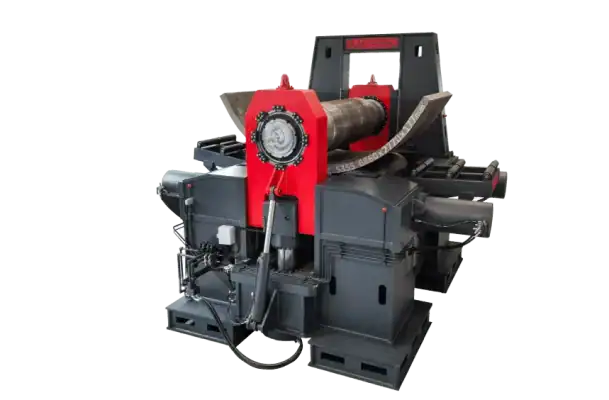
A plate rolling machine usually works with three or four rolls and is designed to pull and bend flat material through repeated passes. Four-roll machines offer good control and are often preferred where repeatability and pre-bending matter. Three-roll machines remain common and are effective, but setup can be more operator-dependent.
Section rolling machines use driven rolls shaped or adjusted to suit the profile being bent. The contact points are critical. If the rolls do not properly support the geometry of the section, the material can mark, distort or twist. For that reason, section rolling is less forgiving when the wrong tooling is used.
This is one of the most important decision points for buyers and estimators. A workshop may be able to roll both plate and sections, but that does not mean every machine on site is suitable for every profile or radius. Capacity figures alone are not enough. You need to know the section size, wall thickness, orientation of the bend and required inside radius.
Tolerances, springback and fit-up
In plate rolling vs section rolling, tolerance control tends to fail for different reasons. With plate, the common issues are inconsistent diameter, flats at the ends and mismatch at the seam. With sections, the problems are more often twist, leg spread, ovality or uneven curvature through the profile.
Springback affects both processes, particularly with higher-strength materials and stainless grades. Plate springback generally changes the final diameter and may require over-rolling to compensate. In section rolling, springback can be less uniform because the profile geometry influences how the section recovers after bending.
For fabrication teams, the key point is that rolled parts should be specified in a way the roller can actually work from. Diameter, centreline radius, inside radius and orientation are often confused in drawings and purchase orders. That creates delays before production even starts.
If a ring has to match a mating flange, say so. If a curved channel must remain open to a certain dimension for bolted assembly, that matters as much as the radius. Good rolled work starts with complete dimensional information.
Material behaviour and finish quality
Material type changes what is realistic. Mild steel is generally the most forgiving. Stainless steel work-hardens and shows marking more readily, so roll cleanliness and handling matter more. Aluminium rolls relatively easily in some tempers but can mark badly and may need extra care to avoid cosmetic damage.
Section rolling adds another layer because not all profiles are equally stable. Hollow sections can deform under pressure. Unequal angle can be awkward to control. Heavier structural sections may require substantial force, but even then the real difficulty is often maintaining profile integrity rather than simply achieving the bend.
Surface finish should not be an afterthought. If the rolled part will be visible, galvanised later, or welded into a close-tolerance assembly, you need to consider marking, edge condition and whether any dressing allowance is needed.
Choosing between plate rolling and section rolling
The simplest way to decide is to start with the function of the finished part. If the component needs a curved surface, shell or formed body, plate rolling is usually correct. If it needs to remain a structural profile while following a curve, section rolling is the right process.
The grey area comes when fabricators try to achieve one with the other. A segmented shell made from flat cut pieces can sometimes replace rolled plate, but it adds welding and grinding. A built-up curved member fabricated from cut and mitred straight sections may avoid rolling, but it increases labour and leaves more welds to inspect and finish.
Sometimes that trade-off is justified. Tight lead times, limited access to rolling capacity or awkward material sizes can push a job towards fabricated alternatives. But when appearance, repeatability or weld reduction matter, proper rolling usually wins.
What buyers should confirm before ordering rolled work
Before placing an order, confirm the material grade, thickness or section size, required radius, quantity and whether the part is a full ring, partial arc, shell or cone. Also confirm any critical faces, weld seams, tangent points and allowable distortion. Those details prevent the usual back-and-forth once production starts.
For section rolling, it is worth being explicit about orientation. An angle rolled the easy way is a different operation from the hard way. The same applies to channel, flat and beam sections. For plate rolling, state whether edge preparation, seam gap control or pre-bending quality is important for downstream welding.
Shops that buy welding and metalworking supplies regularly already know that the best results come from controlling the whole fabrication chain, not just one process in isolation. Rolled parts still need cutting, fit-up, clamping and welding support. A supplier focused on fabrication work, such as ProWeld, understands that these processes are connected.
Plate rolling and section rolling are both standard fabrication methods, but they solve different problems. If the drawing, tooling and material choice all line up, either process can produce accurate, efficient results. The useful question is not which method is better in general, but which one gives you the cleanest route to a part that fits, welds and performs as intended.