










Blog
Laser Welding Application Examples in Fabrication
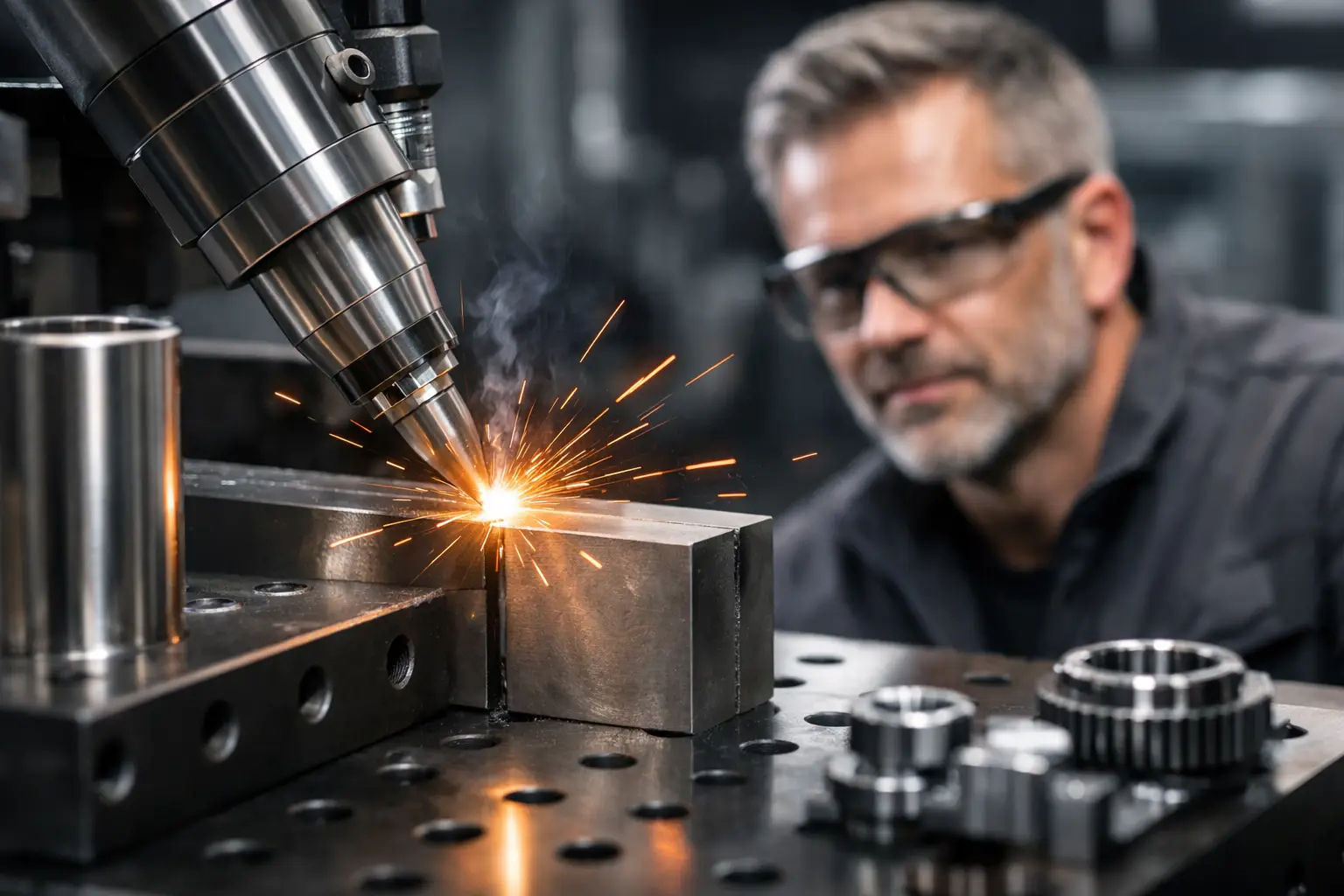
A laser weld can turn a thin stainless enclosure corner, a battery tab or a precision-machined housing into a production-critical joint within seconds. That speed is only part of the case for laser welding. The most useful laser welding application examples show where concentrated heat, low distortion and repeatable automation solve a real fabrication problem – and where conventional MIG or TIG remains the better process.
Laser welding is not a universal replacement for arc welding. It demands close fit-up, clean material and controlled parameters. For the right components, however, it can reduce finishing work, limit heat input and improve consistency across high-volume production.
Laser welding application examples by sector
Sheet metal enclosures and precision fabrications
Thin-gauge stainless steel and mild steel enclosures are among the clearest laser welding applications. Electrical cabinets, control boxes, food-processing guards, laboratory furniture and formed sheet assemblies often require neat external corners with minimal dressing.
A focused laser beam produces a narrow weld zone, which reduces the distortion commonly seen when joining long seams in light sheet. This matters when door gaps, gasket faces and folded returns must remain within tolerance. A fabricator can also use laser welding on visible joints where a clean, consistent bead reduces polishing before powder coating, brushing or passivation.
The limitation is joint preparation. Laser welding will not bridge large gaps reliably without affecting bead profile and penetration. Press-brake accuracy, laser-cut edge quality, fixture design and tack position all influence the result. If the job includes inconsistent parts, galvanised contamination or wide open corner joints, a conventional process may be more forgiving.
Automotive and transport components
Automotive manufacturing uses laser welding for body structures, seat frames, exhaust components, gearbox parts and fuel-system assemblies. The process suits production lines because it can be integrated with robots, vision systems and closely controlled fixtures.
One practical example is the joining of tailored blanks before pressing. Steel sheets of differing thickness or grade can be welded edge to edge so material is placed where a stamped panel needs strength, while weight is reduced elsewhere. Laser welding offers the narrow, repeatable seam needed for this type of engineered blank.
For commercial vehicles and specialist transport equipment, laser welding can also be useful on stainless exhaust sections, sensor housings and compact brackets. Material thickness, coating condition and access remain decisive. A repair workshop dealing with corroded or contaminated vehicle parts should not assume that a laser process will automatically outperform a properly selected TIG or MIG procedure.
Battery packs, busbars and electrical assemblies
Battery production is a major driver for precision laser welding. Battery tabs, busbars, cell interconnects and electrical terminals need low-resistance joints without exposing nearby heat-sensitive components to excessive heat.
The beam can be directed accurately into small connection areas and operated at high speed. This makes it suitable for joining copper, aluminium, nickel-plated materials and combinations used in battery assemblies. Process development is essential, particularly with copper and aluminium, which handle laser energy differently and can be sensitive to surface condition.
Electrical work also places high demands on quality assurance. A joint may look acceptable but still have insufficient penetration, porosity or resistance variation. Production teams commonly validate welds through sectioning, pull testing, resistance checks and process monitoring rather than relying on visual inspection alone.
Medical devices and hygienic stainless fabrication
Medical equipment, pharmaceutical machinery and food-production equipment often contain small stainless steel assemblies where cleanliness and surface finish are as important as strength. Laser welding is used for instrument components, fluid-handling fittings, thin-wall housings and hygienic guards.
Low distortion helps preserve alignment in compact assemblies, while a narrow weld can reduce the area requiring finishing. Where corrosion resistance is critical, the joint must still be protected correctly. Heat tint, shielding gas coverage and post-weld cleaning need proper attention, particularly on stainless steel used in wet or washdown environments.
For fabricators producing hygienic equipment, laser welding does not remove the need for sensible joint design. Crevices, inaccessible laps and poorly finished edges can still create cleaning problems regardless of the welding process selected.
Tooling, moulds and high-value repair work
Laser welding is also established in repair work where adding material accurately matters more than deposition rate. Mould tools, dies, cutting edges, turbine parts and worn precision components can be rebuilt in localised areas, then machined or ground back to size.
The small heat-affected zone is the advantage. A repair can be placed close to finished surfaces or delicate features with less risk of moving the whole component. This is particularly valuable for expensive tooling where replacement would mean long lead times and significant cost.
The trade-off is productivity. Laser cladding or laser repair is not normally the best choice for rebuilding a heavily worn bucket, large structural section or general plant repair. Those jobs may call for conventional weld build-up with suitable consumables, followed by machining where required.
Pipes, tubes and small-diameter assemblies
Laser welding is widely used on tube-to-plate joints, sensor tubes, medical tubing, heat exchangers and compact pipe assemblies. Automated rotary fixtures allow circumferential welds to be made with consistent travel speed and beam position.
For thin-wall tube, reduced heat input can limit collapse and distortion. This helps where internal flow, concentricity or a cosmetic external finish is important. Orbital laser systems can also support repeatable production of similar parts.
Fit-up remains non-negotiable. Tube ends must be square and burr-free, and the joint should be held securely. Where internal oxidation is a concern, particularly with stainless tubing, purge arrangements and shielding gas control should form part of the weld procedure.
What makes a component suitable for laser welding?
Before investing in equipment or sending parts for subcontract processing, assess the component rather than the process brochure. Laser welding is strongest where the assembly has repeatable geometry, controlled gaps, accessible joint lines and a clear reason to minimise heat input.
Material type and thickness set the starting point. Fibre laser welding is commonly applied to stainless steel, carbon steel, aluminium and selected copper-based materials, but the achievable weld profile varies by material, joint type and laser power. Surface coatings, oil, paint and scale can introduce porosity or unstable welding. Clean, consistent stock is a production requirement, not a finishing preference.
Joint design also matters. Butt joints, lap joints, flange joints and outside corners can all be suitable, but each needs an appropriate focal position, travel speed and shielding arrangement. A small change in joint gap can have a larger effect than it would with MIG welding. For that reason, good fixturing is often just as valuable as the laser source itself.
Process control is where the value is won
A fast weld is only useful if it is repeatable. Fabrication managers should specify the acceptance criteria before production starts: required penetration, allowable distortion, surface appearance, leak-tightness, mechanical strength and inspection method. These requirements determine whether a cosmetic autogenous weld is sufficient or whether filler wire, additional shielding or a different process is needed.
Parameter development should include representative coupons and production parts. Check cross-sections for penetration and fusion, then test the assembly in the way it will work in service. A bracket may need fatigue testing; a fluid component may need pressure testing; an electrical joint may need resistance and pull testing.
Laser safety must be treated as an engineering control, not an operator preference. Appropriate guarding, interlocks, extraction, controlled access, eye protection procedures and operator training are essential. Reflections from bright metals can create particular risks, while fumes from coated materials require effective extraction and material controls.
Choosing laser welding against MIG or TIG
MIG welding remains a practical choice for larger fabrications, variable fit-up and work where high deposition rate matters. TIG retains its place for controlled manual work, fine root passes and applications where skilled operator adjustment is valuable. Laser welding earns its position when precision, speed, low distortion and repeatability justify the tighter preparation and capital cost.
The best decision is rarely based on travel speed alone. Consider total cycle time, including clamping, welding, cooling, straightening, grinding, inspection and rework. On a high-volume stainless enclosure, removing minutes of dressing and distortion correction can justify laser welding quickly. On a short-run structural repair with uneven parts, the same process may create unnecessary complexity.
For fabrication businesses considering laser welding, begin with the parts that currently consume time after welding. A clean, repeatable joint with excessive grinding, heat distortion or inspection failures is often a better candidate than the largest weld in the workshop.