









Blog
Submerged Arc vs MIG Welding
If you are pricing a new welding setup for plate work, beam fabrication or repeat production, the question of submerged arc vs MIG welding is not academic. It affects deposition rate, weld quality, labour time, consumable spend and how efficiently the job moves through the workshop. The right choice depends less on which process is better in theory and more on thickness, joint type, production volume and how controlled your welding environment is.
Submerged arc vs MIG welding – the basic difference
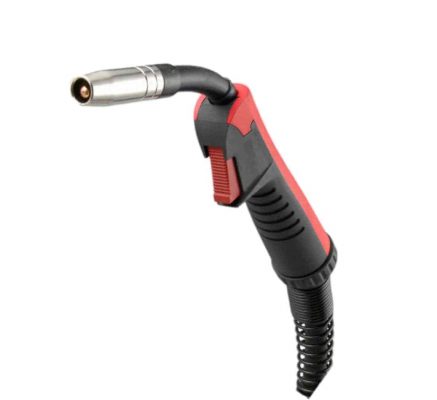
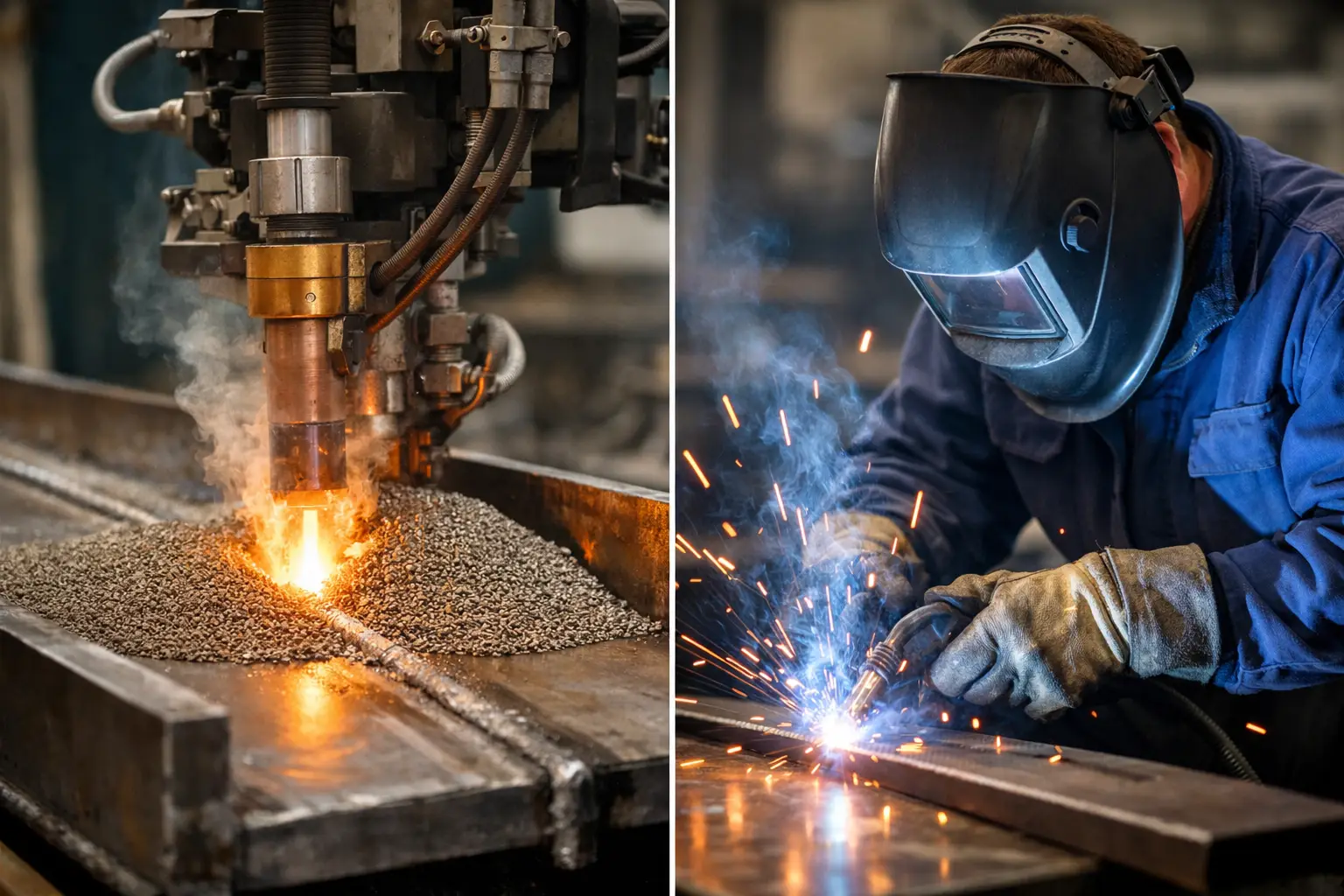
The main distinction is how the arc is protected. Submerged arc welding, usually shortened to SAW, forms the arc beneath a layer of granular flux. That flux shields the molten pool, contributes to slag formation and helps produce a stable, high-deposition weld. MIG welding, more correctly referred to in many industrial settings as GMAW, uses a continuously fed wire and a shielding gas delivered through the torch.
That difference in shielding changes almost everything about how each process behaves. SAW is typically mechanised or automated, works best in flat or horizontal positions and is heavily used on thicker sections. MIG is more flexible, easier to move around the job and widely used for general fabrication, repair and site-related work where access and position vary.
Where submerged arc welding has the advantage
Submerged arc is built for output. On long, straight seams and repetitive work, it can deliver very high deposition rates with deep penetration and consistent bead appearance. For structural fabricators, pressure vessel work, heavy plate applications and large assemblies, that matters because arc-on time converts more directly into completed weld metal.
The process also produces very little visible arc glare and low spatter. Because the arc sits under the flux blanket, weld conditions are stable when parameters are set correctly. In a controlled workshop, that helps reduce post-weld cleaning and supports repeatable quality across batch production.
Another clear strength is efficiency on thick material. If you are welding heavy sections where multiple MIG passes would be required, SAW can often reduce the total number of passes and lower labour input per metre of weld. That is one reason it remains common in industrial fabrication lines where throughput is closely watched.
There is a trade-off. SAW equipment is less versatile on mixed work, setup is more involved, and the process is not suited to every joint or welding position. If the workshop handles varied fabrication rather than long production runs, the theoretical productivity gain may not be fully realised.
Where MIG welding makes more sense
MIG welding earns its place through flexibility. It can be used across a broad range of material thicknesses, is easier to adapt to short runs and changing jobs, and can be used in more positions than submerged arc. For fabrication shops that move from brackets to frames to repair work in a single day, MIG usually fits the workflow better.
It also has a lower barrier to implementation. Equipment is generally more compact, automation is optional rather than assumed, and changeover between tasks is simpler. That gives workshop managers more freedom when workload is mixed or job sizes are unpredictable.
For lighter to medium section steelwork, stainless fabrication and general production welding, MIG often offers the better balance of speed, control and accessibility. It is also the more practical process where welders need to reach awkward joints, work around fitted assemblies or handle shorter seams that do not justify a dedicated SAW setup.
The compromise is that MIG is more exposed to environmental conditions and operator variation. Shielding gas can be disrupted by draughts, and on thicker plate the process may require more passes, more cleanup and tighter parameter control to achieve the same productivity as submerged arc.
Productivity and deposition rate
If the comparison is strictly about weld metal laid down per hour, submerged arc usually comes out ahead. It is designed for heavy-duty continuous welding, and on the right job it can outpace MIG by a clear margin. That does not automatically make it the cheaper process, but it often makes it the faster one for thick-section fabrication.
MIG remains productive, especially with modern wire feed systems and appropriate parameters, but its advantage is broader usability rather than maximum deposition. In a busy fabrication environment, actual productivity is not just arc speed. It includes fit-up variation, repositioning, operator availability and whether the process can move easily from one component to the next.
That is where many buyers need to be realistic. A process that is exceptionally fast on one class of weld may sit idle on the rest of the work.
Weld quality and consistency
Submerged arc is known for producing sound, consistent welds when applied within its operating range. The flux blanket protects the weld pool very effectively, and the process supports controlled, repeatable production. On long seams in plate or section, that consistency is one of its strongest commercial arguments.
MIG can also produce high-quality welds, but it is generally more sensitive to operator technique, torch angle, stick-out, travel speed and shielding gas stability. For skilled welders this is manageable, but the process is less forgiving in poor conditions. Surface contamination, poor gas coverage or inconsistent settings can show up quickly in the finished weld.
If your quality control requirements are strict and the welds are repetitive, SAW has a clear advantage. If your jobs vary constantly and qualified welders need to adapt as they go, MIG offers more practical control.
Joint access, position and workshop fit
This is where submerged arc vs MIG welding becomes less about metallurgy and more about production reality. SAW is best suited to flat and horizontal welding, with accessible joints and parts that can be presented consistently to the arc. It is a workshop process, not a general-purpose answer for every fabrication problem.
MIG is much more adaptable. It can handle fillets, short seams, out-of-position work and assemblies that are difficult to manipulate. If components are small, irregular or produced in low volume, MIG usually integrates more easily into day-to-day fabrication.
For maintenance teams and contractors, that flexibility often outweighs the lower deposition rate. For dedicated manufacturing cells producing the same weld repeatedly, the balance shifts back towards submerged arc.
Consumables, running costs and operator input
Cost comparisons need care because the cheapest process on paper is not always the cheapest over a month of production. SAW uses wire and flux, and flux handling needs to be factored in. However, because deposition rates are high and spatter is low, the cost per metre of finished weld can be very competitive on suitable work.
MIG uses shielding gas and wire, and depending on transfer mode and setup, there may be more spatter and more post-weld dressing. Labour input can rise on thicker materials where extra passes are needed. On the other hand, MIG equipment and process changeovers are often simpler, which matters if jobs are short-run or varied.
Operator skill also affects cost. SAW relies heavily on setup, procedure control and usually mechanised travel. MIG places more of the result in the hands of the welder. In shops with strong welding discipline, both processes can perform well. In shops where consistency varies between shifts or operators, process selection can have a direct impact on scrap, rework and throughput.
Which process suits which application?
For heavy fabrication, large plate weldments, vessels, beams and repetitive structural work, submerged arc is often the stronger option. It rewards volume, consistent joint preparation and jobs where automation or mechanisation can be justified.
For general fabrication, repair, maintenance, medium-section assemblies and work involving varied positions or awkward access, MIG is usually the more practical choice. It is easier to deploy across a wider range of components and does not depend on the same level of positional control.
A lot depends on whether your business is production-led or jobbing-led. If your work is repetitive and measured in metres of weld, SAW deserves serious consideration. If your workshop lives on mixed fabrication and fast turnaround, MIG will usually cover more of the work with fewer compromises.
Making the right buying decision
When evaluating submerged arc vs MIG welding, start with the work mix rather than the process brochure. Look at material thickness, weld length, position, batch size, quality requirements and how often the same weld repeats. Then consider floor space, power availability, handling equipment and whether the team can support mechanised welding properly.
It is also worth thinking beyond the welding bay. Joint preparation, consumable storage, fume management, cleaning time and inspection requirements all influence the real cost of the process. A faster weld is only valuable if the rest of the operation supports it.
For many fabrication businesses, the answer is not either-or. MIG may remain the general workshop process, while submerged arc is introduced for specific heavy, repeatable jobs where its productivity advantage pays back. That is often the most sensible route because it matches equipment spend to actual workload rather than theoretical capacity.
If you are choosing for commercial fabrication, buy for the jobs you do every week, not the occasional contract that looks impressive on paper. The best welding process is the one that gives you consistent quality, predictable cost and the least friction on the shop floor.