








Blog
Welding Positioner Review for Fabrication Shops
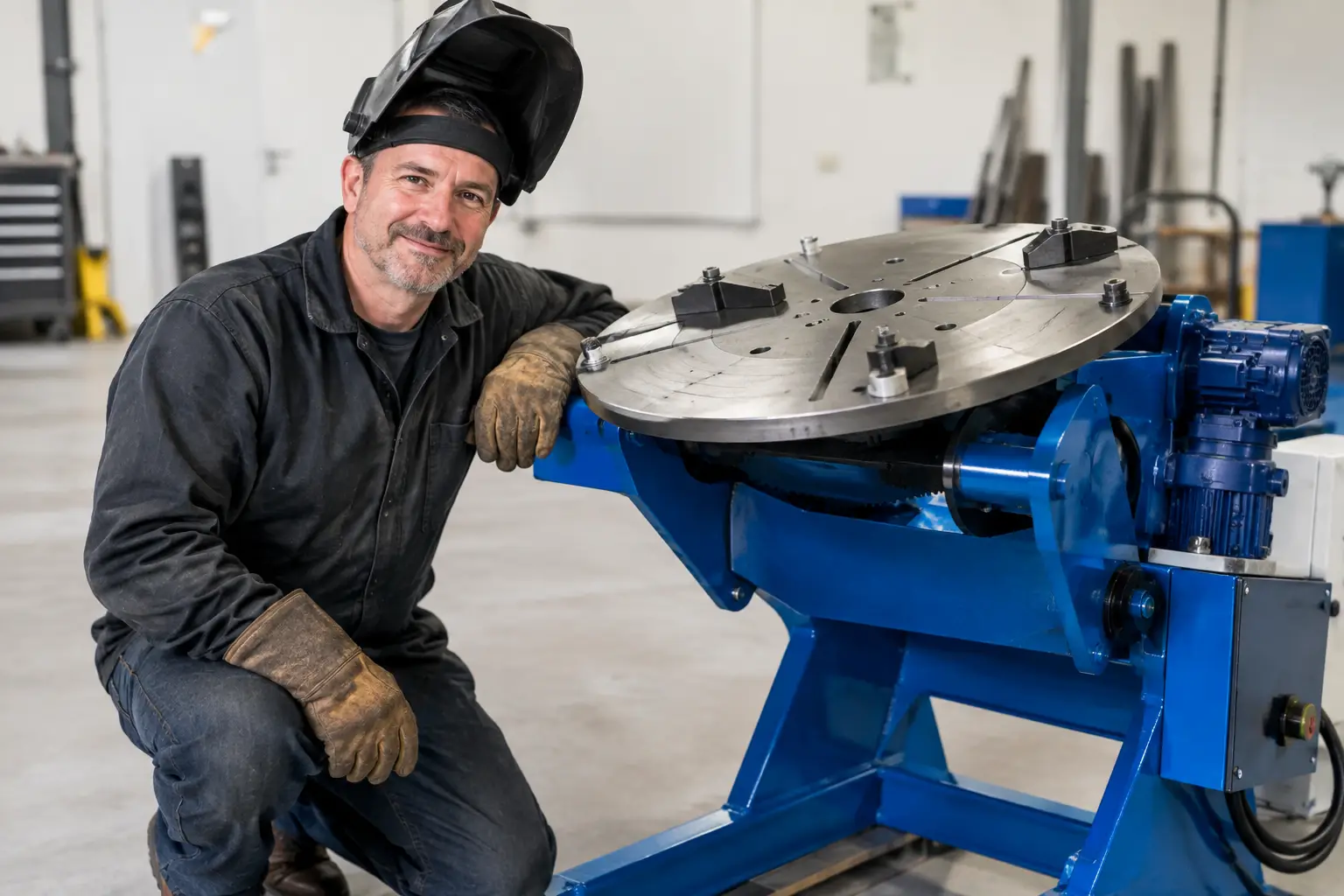
A welding positioner earns its place when it removes the repeated handling, awkward torch angles and stop-start work that slow down circular fabrication. This welding positioner review focuses on the factors that matter in a working shop: real load capacity, controllable rotation, workholding, duty cycle and safe operation. The right unit improves weld consistency and keeps the welder in a stable, productive position. The wrong one becomes an expensive turntable that is too slow, underpowered or poorly suited to the parts passing through the bay.
What a Welding Positioner Should Deliver
A positioner rotates a component at a controlled speed so a weld can be made in the flat or horizontal position wherever possible. That may mean a pipe spool, flange assembly, tank end, valve body, bracket or fabricated cylinder. Instead of walking around the part or repeatedly stopping to reposition it, the operator holds a consistent travel angle while the work rotates.
The gain is not simply speed. A stable welding position supports more consistent bead profile, better tie-in and less fatigue over a shift. It can also reduce the need for overhead or vertical-up welding where the joint design allows. For repeated production work, those improvements can have a direct effect on labour time and rework.
However, a positioner is not automatically the answer for every circular job. Large, long or flexible assemblies may need roller beds, column-and-boom equipment or purpose-built rotators. Small one-off brackets may take longer to fixture than to weld by hand. The strongest case for a positioner is repeatable work where the component can be securely clamped and the weld path benefits from controlled rotation.
Welding Positioner Review: The Specifications That Matter
The headline capacity on a data sheet is a starting point, not a purchasing decision. Positioners are commonly rated for a centred load, close to the faceplate, with the table level. Fabrication work rarely behaves so neatly.
Capacity and centre of gravity
A 300 kg rated positioner does not necessarily handle a 300 kg fabrication safely when that fabrication is offset from the table. An extended pipe section, heavy flange or eccentric assembly creates torque around the tilt axis and places greater demand on the drive, gearbox and bearings.
Ask two questions before selecting a unit: what is the heaviest complete assembly, including chuck and fixture, and how far is its centre of gravity from the faceplate? A smaller but well-centred workpiece may be suitable, while a lighter but overhung component may not be. If there is any doubt, allow a sensible capacity margin rather than working at the published limit every day.
Tilting models need particular attention. Their rated load may reduce as the table moves away from the horizontal position. Check the manufacturer’s load chart where available and confirm that the locking arrangement is designed for the way the work will be presented.
Rotation speed and control
A useful positioner needs a speed range that matches the welding process and joint diameter. Slow, stable rotation is essential for circumferential TIG work and controlled root passes. Higher speeds can suit preparation, tack-up, cleaning and some MIG production applications. What matters is not the maximum rpm alone but smooth movement at low speed without surging.
Foot-pedal control is valuable where the welder needs to start, stop or make small adjustments without putting down the torch. A forward/reverse function is equally practical when returning to a tack or correcting the work position. For repetitive production, variable speed control should be predictable enough that the operator can set a repeatable weld travel rate rather than constantly chasing it.
Look closely at the drive system. A geared motor with an appropriate reduction ratio generally offers controlled low-speed rotation and good torque. Light-duty units with poor speed regulation can hunt or hesitate, particularly when the load is uneven. That inconsistency shows up in the weld.
Faceplate, chuck and fixturing
The faceplate is only as useful as the workholding fitted to it. A three-jaw chuck can suit round bar, pipe and regularly shaped components, while a four-jaw independent chuck gives more control over irregular work. Dedicated fixtures are often the best option for repetitive assemblies because they locate the part accurately and reduce set-up time.
Confirm the faceplate diameter, mounting pattern and available bore before buying. A large bore can be useful for passing pipe or shaft material through the table, but it does not replace proper support for long workpieces. If a component projects a significant distance from the positioner, a tailstock, steady support or roller stand may be required to prevent deflection and vibration.
Do not rely on a chuck to compensate for poor fixture design. The part must be held against rotation and lifting forces, with enough clamping area to remain secure during starts, stops and tilt movements. Tacks alone are not a fixture.
Tilt range and access
A flat rotating table works well for many flange, plate and pipe applications. A tilt or headstock-and-tailstock arrangement becomes more useful when the joint needs to be brought into the optimum welding position from several angles. The trade-off is higher cost, more floor space and a greater need to assess the load’s centre of gravity.
Check access around the positioner as it will be installed, not just as it appears in a catalogue photograph. The operator needs room for the torch, leads, fume extraction and safe loading. Forklift or overhead lifting access may also be needed, particularly where the work is too heavy to mount manually.
Build Quality, Safety and Workshop Suitability
For workshop use, the mechanical construction deserves as much attention as the control panel. Examine the table rigidity, bearing arrangement, gearbox quality and stability of the base. A positioner that flexes under load makes accurate set-up difficult and can contribute to uneven rotation.
Electrical protection should suit the workshop environment. Metal dust, grinding debris and welding spatter are normal conditions in fabrication, not exceptional ones. Controls should be protected but accessible, and cables should be routed so they are not exposed to hot work, sharp edges or vehicle traffic.
Safety features should include an accessible emergency stop and a clear means of isolating power for set-up and maintenance. On tilting units, positive mechanical locking and controlled movement are essential. Operators must understand that a positioner is moving machinery. Loose clothing, unsecured leads and unsupported workpieces create obvious hazards, especially on larger rotating assemblies.
Earth return arrangement also requires thought. Use a suitable welding earth path and maintain clean contact surfaces where the equipment design requires it. Poor earthing can lead to arcing through bearings or electrical components, causing damage that may not be visible until the rotation becomes rough or unreliable.
Choosing the Right Type for the Job
A compact bench positioner is suitable for small fabricated parts, pipe fittings, flanges and repair work where manual loading is practical. It is often the best entry point for a workshop that needs better access and consistency on short-run jobs.
A floor-standing positioner with a larger faceplate suits heavier vessels, fabricated housings and repeat production. It provides more capacity, but it must be matched to the actual footprint, lifting method and component geometry.
For long cylindrical sections, conventional roller rotators may be the better choice. They support the work along its length and avoid placing all bending load on a faceplate. If the work includes variable diameters or non-circular forms, adjustable roller arrangements and purpose-designed cradles may be needed.
A headstock-and-tailstock system is effective for shafts, beams and long assemblies that need support at both ends. It offers strong positional control, though set-up can be slower than a simple table positioner. The right choice depends on the components being produced repeatedly, not the occasional job that looks impressive on a specification sheet.
Where the Return on Investment Comes From
The financial case is usually strongest where operators are welding the same family of parts week after week. Reduced handling time, fewer awkward-position welds and more reliable travel speed can add up quickly. The saving may come from shorter cycle times, but it can also come from reduced grinding, less weld repair and lower physical strain on skilled staff.
Before ordering, time a representative job from loading through to unloading. Include the current handling and repositioning steps, not only arc-on time. Then consider the fixture time that a positioner will introduce. If a dedicated jig cuts that set-up to seconds, the positioner may transform the job. If every component is different and requires extensive clamping, a flexible workbench arrangement may remain more efficient.
For professional fabrication teams, a welding positioner should be selected as part of the whole process: the part, the fixture, the lifting method, the welding procedure and the operator’s working position. Specify it around the work you actually make, leave margin for real-world loading, and it will become a dependable production tool rather than another machine waiting for the right job.